
25 Aug 2026
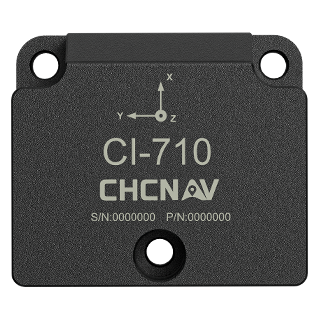
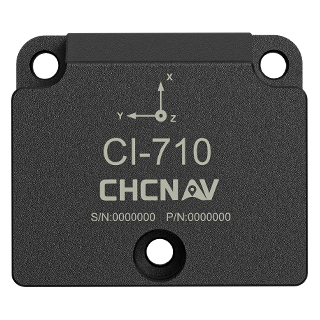
Inside a plant, the satellite signal that guides a vehicle down a street is not available. Roofs, steel structures and racking block it, yet the machines on the floor still need to know how they are moving: how far a chassis has rotated, whether a mast is leaning under load, how a robot body is oriented as it reaches for a part. That data has to come from onboard sensing, and it has to stay stable across a full shift. Our CHCNAV CI-710 high-precision MEMS IMU is built for that job.
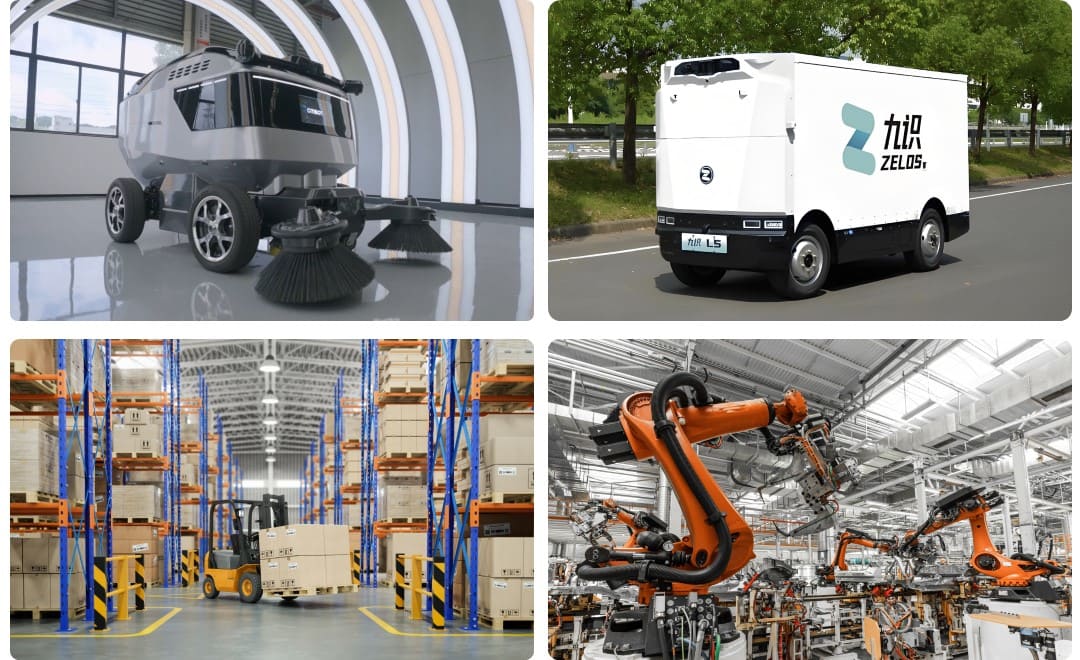
Modern AGVs and factory robots rely on precise motion and attitude feedback as one part of their navigation and control systems to operate safely and efficiently in environments where external positioning signals are limited or unavailable. Unlike outdoor autonomous vehicles, indoor machines must navigate around racks, equipment and moving obstacles while maintaining stable orientation during acceleration, turning, lifting and manipulation tasks.
An industrial IMU provides the continuous motion reference needed by the vehicle controller to understand short-term movement changes and maintain stable control throughout the production cycle.
For industrial vehicles and robots, maintaining a reliable motion reference depends on how well the IMU minimizes drift, compensates for temperature changes, and provides high-rate data for real-time control.
The CI-710 is a 6-degree-of-freedom MEMS inertial measurement unit. It outputs tri-axis angular rate, tri-axis acceleration and temperature, and an embedded VRU algorithm turns that data into the roll and pitch of the carrier. On a plant floor this is what lets an AGV track how far it has turned between two waypoints, a stacker detect that its mast is tilting, and an inspection robot know the orientation of its own body before the vision system interprets what it sees. None of it depends on a satellite fix, which is what makes it usable under a roof.
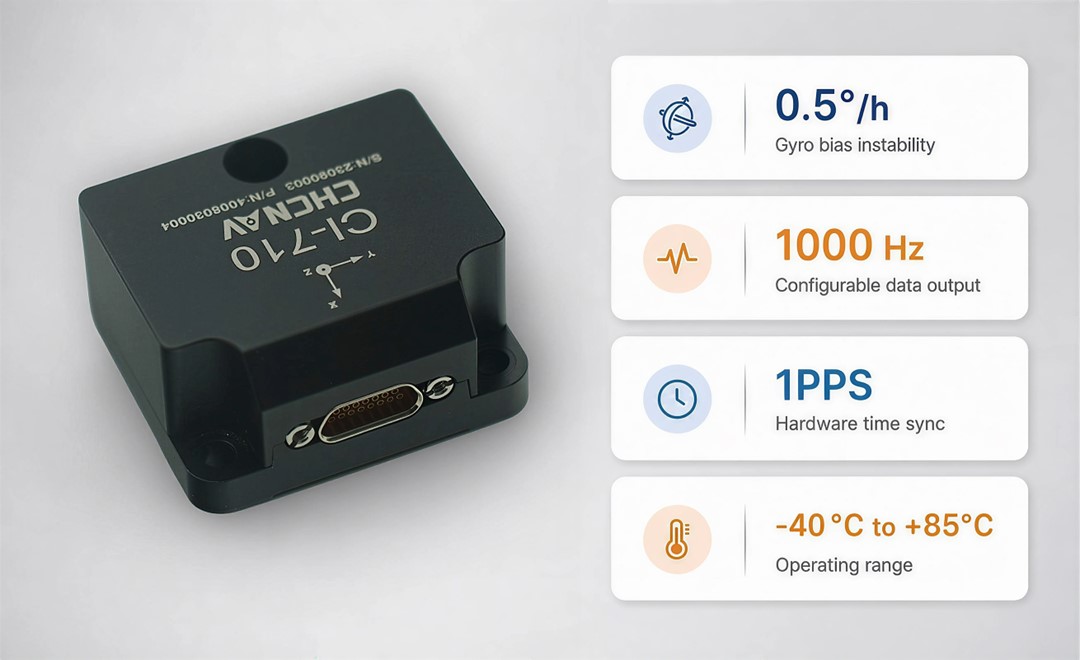
Two figures decide whether an industrial IMU can hold a control loop. The first is gyro bias instability, and multi-sensor array calibration brings the CI-710 to 0.5°/h. The second is what happens to that figure when the temperature moves. Every unit is calibrated on a turntable across the full -40°C to +85°C operating range, compensating bias, scale factor, nonlinearity and cross-coupling error. A workshop that is cold at the start of a shift and warm by mid-afternoon does not pull the sensor off calibration, so the control system follows the machine instead of correcting for thermal drift.
Fast machines need fast data. The CI-710 communicates over an RS422 differential port at up to 1500 Kbps and can be configured to output raw motion data at 1000 Hz. At that rate a change in attitude reaches the controller within a millisecond or two, which is what closed-loop motion control on a high-speed AMR, a sorting robot or a heavy automated crane depends on. Sampling too slowly shows up on the floor as jitter on a straight run, overshoot coming out of a turn, or a pallet set down a few centimetres off.
Few automation stacks run on a single sensor. LiDAR, cameras and, where outdoor operation is required, GNSS can all feed the same estimator, and fusing them is largely a question of whether their timestamps agree. Built-in 1PPS synchronisation aligns CI-710 output to whole seconds and gives every stream a shared reference. That removes much of the integration work in in-plant SLAM mapping, automated facility surveying and multi-robot production lines, where a few milliseconds of timing error becomes centimetres of position error.
The CI-710 carries multiple gyroscopes and accelerometers rather than a single pair, so data output continues if one sensor fails, which matters on a line that runs around the clock. It is built to keep working through the vibration, knocks and load impacts of an operating plant. The housing is compact and standardised and the RS422 interface is one mainstream industrial controllers already speak, so integration is a wiring and protocol task rather than a development project.
As a dedicated inertial sensing layer within an autonomous system, the CI-710 provides the attitude and motion data that support a range of industrial applications, including:
For AGVs and factory robots, the CI-710 acts as a core motion-sensing component, providing the attitude and movement data required for autonomous navigation, robotic positioning and real-time control.
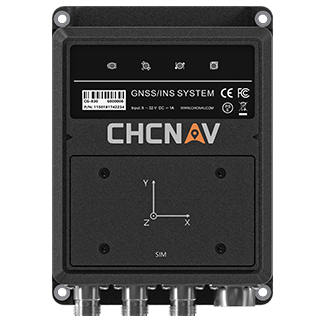
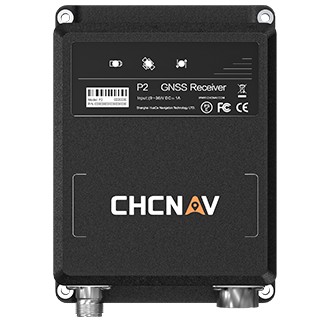
Inertial sensing is one layer of the stack. Where a machine moves between indoor and outdoor areas, our CGI-610 dual-antenna GNSS/INS system and CGI-230 automotive-grade GNSS/INS system combine satellite positioning and inertial measurements into a unified navigation solution. Check our explainer on how inertial navigation works sets out the difference between the two layers, and our navigation and positioning solutions show how they combine on autonomous machines, from plant vehicles to humanoid robots.
CHC Navigation (CHCNAV) develops advanced mapping, navigation, and positioning solutions designed to increase productivity and efficiency. Serving industries such as geospatial, agriculture, machine control and autonomy, CHCNAV delivers innovative technologies that empower professionals and drive industry advancement. With a global presence spanning over 140 countries and a team of more than 2,200 professionals, CHC Navigation is recognized as a leader in the geospatial industry and beyond. For more information about CHC Navigation [300627.SZ], please visit: https://navigation.chcnav.com/about/overview
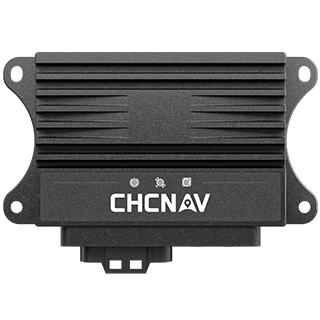
CHCNAV CI-710
High-Precision MEMS Inertial Measurement Unit